A small model that never stops learning: Alpha, AlphaOS and knots#
We think a small language model can keep getting smarter after it ships. It needs three things at once: we can see inside it, it lives in a system that can change it while it runs, and it learns from everything that happens to it. Each of those is one of our projects.
- Knots are how we see inside. A knot is a direction in the model's internal stream that stands for a concept, and every knot is its own instance of AlphaOS, which runs when that concept lights up.
- AlphaOS is the system the model lives in. It is one program that stays resident on the GPU, schedules its own work and loads new code without being launched again.
- Alpha is the compiler that builds all of it, from the mathematics of the model down to the GPU's own instructions, with no CUDA underneath.
- Continuous learning is the habit. Our chat model, omega, is tested on each of our team's video calls before it has heard it, and then learns from it. Since 23 November omega is the 1.38B model Alpha trained, served by PyTorch on CPUs, outside AlphaOS, and it learns nothing until an experiment now running decides how it should.
The claim we are working toward is that a model you can measure can be smaller, because you know what it is missing and can add exactly that. Nobody has shown this yet, including us. This post puts everything we have built and measured toward it in one place, and that includes the parts that failed.
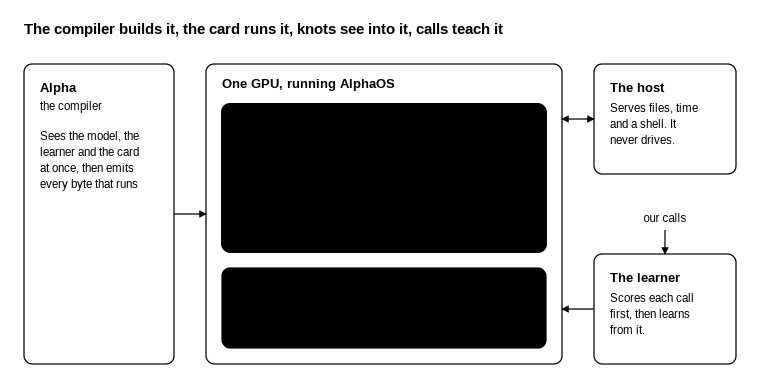
This is the design. The compiler builds everything on the card, the model lives inside AlphaOS, an AlphaOS instance runs at every knot, and the learner changes the model after every call. Today these are still two systems: AlphaOS trains its own GPT-2 on the card, and omega learns from our calls on CPUs.
Alpha: a compiler that sees the whole learning system#
On 22 October 2026 Alpha trained a 1.38-billion-parameter model on two rented H100s in 6 hours 32 minutes, at the same speed as nanochat, whose public record the model comes from. The trainer was one executable of 9.9 MB that Alpha compiled. No CUDA runtime, no NCCL and no PyTorch were on the training path.
Alpha is a dependently typed language and compiler we wrote from scratch. A model, its learner, its tensors and the device are separate components. The compiler sees the whole system before it specialises it and emits every byte of host and GPU code.
| Alpha | nanochat, same hardware | |
|---|---|---|
| Model | nanochat d24: 24 layers, width 1,536 | the same |
| One H100, seconds a step | 8.364 | 8.442 |
| Two H100s, tokens a second | 247,865 | 247,886 |
| Gain from the second card | about 1.98 times | 1.996 times |
| Whole schedule (5,568 steps, 5.84 billion tokens) | 6 h 32 min on two cards | record: 99 min on eight |
| Quality (CORE, 22 tasks) | 0.2089 | record: 0.2626 |
- It costs about $57 at RunPod's price today. Two H100s joined by NVLink come only on RunPod's secure cloud, at $4.39 a card-hour, and the run took 6.5 hours.
- It fell short on quality. The bar for "GPT-2 grade" is 0.2565, the score of GPT-2 at 1.6 billion parameters. Ours reached 0.2089, and validation is 0.754 bits a byte against the record's 0.718. Data order is ruled out; the cause is narrowed to the gradients inside the blocks, below. Eight cards have not run.
- It can chat. After nanochat's own chat fine-tune it scores 48.7% on ARC-Easy and 33.3% on MMLU. The run is recorded in the repository. The weights are on Hugging Face as alpha-nanochat-d24, and after the chat fine-tune as alpha-nanochat-d24-sft.
Speed is not the point of Alpha. Its stated purpose is "to make novel algorithms, optimisations, and learning systems easier to discover". The speed run shows the compiler is good enough to stand on. Because it owns every byte, it can also build things a framework cannot, and AlphaOS is the first of them.
AlphaOS: one resident program on each GPU#
AlphaOS is an operating system that lives on the graphics card. Its design document puts it in one line: "The host launches exactly one thing, once per GPU: the AlphaOS image. After that, kernels are dead."
A normal trainer drives the card from the CPU. It launches small programs (kernels) one after another, and between launches nothing on the card persists. Alpha's own GPT-2 small trainer makes 258 launches an update; an 80-block model we have since archived made 5,017. AlphaOS turns that around. Each of the card's processors becomes a worker that pulls tasks from a queue, and the host is treated as the card's internet: it serves files, time and a terminal, and relays messages between cards, but it never drives.
What AlphaOS does on the card:
- schedules ready work across every processor, by dependency;
- manages memory and a namespace of named objects;
- connects programs with pipes;
- loads and runs new compiled code without being launched again.
What exists today:
- It runs on real cards. On 23 October thirteen test programs that had passed in our CPU emulator of the chip ran on two rented RTX 3070s, and eight matched the emulator byte for byte. The record is here.
- A model learns inside it. A model shaped like GPT-2 small, 163 million parameters, trains as one task graph across the card's 46 processors: 142 ms an update on one RTX 3070, and about 49,500 tokens a second on two.
- It is slower than launching so far. Alpha's launched GPT-2 small trainer takes about 110 to 114 ms for an update of the same size, with a simpler learner, so the resident version is about 25 to 30% slower. The two-card target of 100,000 tokens a second was not reached; a branch not yet merged reached 72,300.
- Its best model is undertrained. The longest run, 30,000 updates on an RTX 3090, reached a held-out loss of 4.77. A trained GPT-2 small is near 3.3.
- It runs on a second chip. The shell, the loader, the views and small programs run natively on the DGX Spark's GB10, which needed its own machine layer and an ARM host. GPT-2 has not trained there, and AlphaOS does not run on an H100 yet.
The reason to want this is the loop it makes possible. Code can be compiled, checked and loaded into a system that is already running. So an agent can watch a learner, change it in Alpha, prove or test the change, and load it, without stopping anything. The vision document says it this way: "Learning never stops for a relaunch." A model that keeps learning needs a home that can keep changing.
Knots: reading and writing what a model is thinking#
A knot is an instance of AlphaOS tied to a named place inside a model. The place is a direction and a threshold at one depth of the model's internal stream. When the stream at a word points far enough along the direction, the knot fires and its instance runs.
The first plan defines it in one line: a knot is "AlphaOS installed at a named place inside a language model". It says knots would "find each other and talk over pipes of frequencies, never over words", and that the aim was to "solve mechanistic interpretability from the inside". The next section is about the instance. This one is about the place.
Tying a knot takes four steps: write examples of a concept and of its opposite, take the difference of the model's average state on each, check it on text held back, then choose the depth and the label. Our notes say it plainly: "Tying a knot is cheap. Tying one that means what its label says isn't."
The runtime treats a knot as more than a direction. In the second plan it is a reader, a writer, a scope, state, a calibration, permissions, a budget and postconditions. Each reader and writer needs a certificate, which is a measured record of how well it works on one model. A write without one is refused.
On the card, AlphaOS measures every word of the stream against every tied knot while the model trains, and the model computes bit for bit what it would have computed without them. One model's 1,179 knots, their firings and all 163 million of its parameters can be flown through in a browser explorer. A .knot file carries a model together with the knots tied in it.
One correction came early and we kept it: knots are labels for the black box, and they never change the weights.
What we have measured#
Reading a model with knots works well. Writing into it works a little, and not safely. Knots do not learn. That is the short version of more than thirty experiments, most of them run once against bars fixed beforehand. The audit regenerates the earlier experiments' tables from their raw records.
| Question | Result | Kind | For the vision |
|---|---|---|---|
| Do knots matter causally? | 968 of 1,075 pass (90%); 1 of 104 controls | Fixed in advance | Holds |
| Does a knot steer the text? | 9 of 10 concepts on GPT-2; 1 of 10 on our own 30,000-update model | Fixed in advance | Holds on a well-trained model |
| Does a program that times its writes by meaning beat random timing? | +19.7 points [+12.8, +26.9] | Fixed in advance | Holds |
| Can a write change one thing and leave another alone? | A scoped write succeeded 48.8% of the time and passed its checks; a stricter test kept protection at 55.5% against a bar of 65% | Fixed in advance | Mixed |
| Do two programs compose? | Not confirmed in three rounds | Fixed in advance | Fails |
| When do the abilities appear in training? | Reading by step 2,000, steering peaks at 32,000, scoping still rising at the end | Descriptive | Reading comes first |
| On a compiled program whose truth we know? | Reading exact (AUC 1.00); a write gives the right output 323 times in 600 | Exploratory | Read yes, write no |
| Is the stream a channel for messages? | A plain host queue wins on every count; a frequency code is no better than a random one | Descriptive | Cuts "pipes of frequencies" |
| Does text follow music? | The piece is named from the text 31.2% of the time; chance is 8.3% | Fixed in advance | Holds |
| Does a conducted program beat the same writes at random times? | 44.1% against 35.1%; a plain stronger write gets 55.9% | Fixed in advance | Mixed |
| Can anyone tell when every block's gain sways with the music? | No: AUC 0.508 | Exploratory | Cuts "every weight moves" |
| Are our readers good enough to trigger a program? | They fire by mistake in 17% and 29% of short texts; the aim is 1% | Certificates | Not yet |
| Does a knot learn from data? | It gets 6% of what one trained vector gets | Fixed in advance | Fails |
| Does a knot help answer plain questions? | Our 30,000-update model: 2 of 24 without it, 0 of 24 with it | Exploratory | Fails |
| Do knots read a bigger model better? | 1.000 in our 1.38B model, 0.975 in GPT-2 small, 0.925 in an untrained GPT-2 | Exploratory | Too easy to tell |
The first report lists four claims it does not yet make: that a full operating system runs at each knot inside GPT-2, that knots communicate in any rich sense, that the pipes are frequencies in a physical sense, and that the space is a tree. Results on development data also flatter. One of ours came in about two and a half times smaller when run on held-out material.
Continuous learning: omega learns from every call#
A model that keeps learning from each of our calls predicts the next call better than one that stops, in 15 of 15 calls, and the gap grows. That was tested once, on calls held out beforehand, and all four claims held. The report names two limits: those calls had been opened once before, for an earlier experiment, and the test confirms the learning setting, not the service's own learner code.
Until 23 November omega was OpenAI's GPT-2 small with its last three blocks trained on the transcripts of our team's video calls, in PyTorch on the CPUs of one shared server, not on Alpha. That morning a learner started running beside it every ten minutes. For each finished call it does four things in order: scores the published model on the call before learning anything from it, takes one pass over it mixed with older calls and plain web text, checks that older calls and web text have not got worse, and publishes the new weights. If either check ever drifts too far it halts itself. That afternoon omega moved to our 1.38B model, below.
| Model, scored on 16 held-out calls | Bits a token | Choices per word |
|---|---|---|
| GPT-2 small as it ships | 5.943 | 61.5 |
| Trained once on 55 earlier calls, then frozen | 5.762 | 54.3 |
| Kept learning through 8 more calls, then stopped | 5.702 | 52.1 |
| Kept learning through the held-out calls too | 5.681 | 51.3 |
- Training on our calls works. One fine-tune was better on 16 of 16 later calls and kept 90% of its gain five weeks on. It still missed the bar we had set for it (0.180 bits against 0.193), so by our own rule that claim failed.
- Carrying on adds 45% to that. Nothing we measure was forgotten: older calls improved and web text moved by 0.002 nats.
- The gain is small. Learning through the last five weeks is worth 1.4% fewer choices per word.
- It does not make the model clever. In a probe of 24 plain questions, omega answers 5. Qwen2.5-0.5B-Instruct, an open chat model four times its size, answers 22 through its chat template. Predicting our words better is not the same as knowing things.
The learner reads transcripts through a database account that sees the text, its timing, a participant number and whether an agent said it, but no names and no accounts. Its log holds counts and losses, never words.
Every knot is an instance of AlphaOS#
Every knot is its own instance of AlphaOS. The knot is the address: a named direction at one depth of the model. The instance is what lives there: a small compiled operating system with its own program and its own files, which runs whenever that place lights up. In the first plan's words, "meaning carries its own name and its own program at the place where it lives". Asking what a part of the model does becomes reading the knot tied there, and asking it to do something different becomes patching that knot.
How far it is built:
- knots/1 builds it whole. The knot module describes itself as "AlphaOS tied at named regions of a vector space". A knot is a direction, a threshold, a layer, three carriers and a loaded program. When its region fires, the program is pushed onto the same ready queue as all other work on the card, so knot instances compete for the machine. Knots and files share one heap, and a knot is tied, renamed and untied through requests like any other system call. In knots/1 each knot also has processes, pipes and a command line, and its program can be patched while it runs.
- Inside GPT-2 it is half built. Since 30 October a knot can name its own AlphaOS image, checked and installed on the card by a loader. It runs once for every word its knot fired on, within the scheduler's budget, with its own file and its own outbox. Knot programs, a knot scheduler and pipes ran on an RTX 3090 on 29 and 30 October.
- Not yet inside GPT-2: processes, pipes between instances, and a command line to each knot. Until they arrive, our first report does not claim a full operating system at each knot inside GPT-2.
Thousands of instances should cost pointers. The .knot format is designed to store identical knot images once, by their hash, an idea from Eiichi Goto, who invented both the parametron and hash consing. Tying a knot then becomes a lookup.
Why it needs a megakernel. In a conversation that shaped the design, the idea was put this way: knots put "the operating system instructions alongside the weights, but the mega-kernel just executes them when it finds them". A launched trainer pays for every piece of work it launches: An 80-block model we have since archived made 5,017 launches in one 829 ms update on an RTX 3090. An instance at each of a thousand concepts, on every word, cannot be paid for that way. Inside a resident AlphaOS, a knot's instance is one more task in the same graph, on the same queue as the model's own arithmetic.
What each instance should do. Our results say reading is reliable and writing is not. So the four jobs we would give the instance at a knot are mostly about reading. Only part of the first exists today: the firing records.
- Watch. Record when the concept fires, and warn the learner when a concept drifts.
- Remember. Use the knot's files as memory: what came next the last time the model was here.
- Ask. Fetch what the model does not know through a protocol to the host, which is the card's internet.
- Teach. Mark the words the model got wrong at this concept, so the learner trains on those.
Writes into the stream stay in the toolbox for the cases that have earned a certificate.
Small models, because we can measure them#
Our bet is that a model we can read can be taught exactly what it lacks, and so can stay small. Big models are big partly because nobody can see what a small one is missing, so size and data get added blindly. This is the newest and least tested part of the plan: a bet, not a result.
Why we think the instrument is good enough to try:
- Reading arrives first. In Pythia-160M's public training run of 143,000 steps, concepts were readable by step 2,000, while steering was still weak; steering peaked at step 32,000.
- Reading is exact where we know the truth. On programs compiled into a transformer, every two-valued variable was read at AUC 1.00.
- A reader survives the model changing. From step 2,000 on, readers fitted on the finished model read earlier checkpoints as well as those checkpoints' own readers did. A model that keeps learning needs that.
What measurement could buy, in the order we would try it:
- A list of what is missing. Tie the same knots in a small model and a big one, and rank concepts by how much better the big one reads them. Teach those first.
- Knowledge kept where it is cheapest. Alpha's SmolTalk fine-tune of GPT-2 small answers in the right form with the wrong fact: "The capital of Italy is Paris." The form is in the weights. The facts can sit in a memory beside the model, addressed by knot, and move into the weights only if they keep being used.
- Work spent where something is happening. Most words need little. A plan written on 24 October, since superseded, named less computation per token as the first research experiment, worth an estimated 2 to 2.5 times. Knots are one way to decide which words need the work.
- Learning checked concept by concept. The learner checks two numbers before it publishes. With knots it could check a thousand.
The starting point is plain. Our GPT-2-sized models answer 2 to 7 of 24 simple questions, and an open chat model four times their size answers 22. Our own 1.38B model answers 19. That gap is the size of the job, and the model that closes most of it is one we already have.
Our 1.38B model, studied for the first time#
Our biggest model answers 19 of 24 plain questions. That is three fewer than an open chat model about a third its size, and far ahead of our GPT-2-sized models, which answer 2 to 7.
The model is nanochat's d24, trained by Alpha on two H100s as described above, then given nanochat's chat fine-tune. Until today it had been through benchmarks and nothing else: no knots, no probing, no learning from our calls. These tests ran on the CPUs of our shared server, in nanochat's own PyTorch code, at about four tokens a second. The record is here.
| Model | Parameters | Plain questions answered, of 24 |
|---|---|---|
| Qwen2.5-0.5B-Instruct (open, for comparison) | 494 million | 22 |
| Alpha's nanochat d24, chat fine-tune | 1.38 billion | 19 |
| The same 1.38B model with its lookup tables switched off | 1.38 billion, 604 million of them zeroed | 8 |
| Alpha's GPT-2 small, persona fine-tune | 124 million | 7 |
| GPT-2 small as it ships | 124 million | 6 |
| Omega: GPT-2 small, trained on our calls | 124 million | 5 |
| Alpha's GPT-2 small, SmolTalk fine-tune | 124 million | 5 |
| Our AlphaOS-trained GPT-2, 30,000 updates | 163 million | 2 |
- It knows facts. Every capital, Jupiter, Shakespeare, a spider's eight legs, the symbol for gold.
- It cannot do arithmetic. It explained the order of operations for 2 + 2 without giving an answer, and said 100 minus 37 is 75. It also said the past tense of "go" is "go".
- Much of what it knows sits in lookup tables. 604 million of its 1.38 billion parameters are value embeddings: tables looked up by token, not multiplied. With every table switched off it answers 8 of 24, and the replies stay fluent while answering the wrong thing: Japan's capital becomes London, gold's symbol Hg, Hamlet's author Arthur Conan Doyle. DeepSeek's Engram work found the same shape in 2026: without its lookup table a model kept 29 to 44% of its factual performance.
- How each was asked. The chat models were asked through their chat templates and the others as text to continue; every reply was scored the same way.
Knots read it perfectly, and that is the trouble. We tied the ten pole-pair knots, hot/cold to safe/dangerous, at every depth of three models. Each sentence was read only after the concept's own word, so the knot had to find what the model carried forward.
| Model | Best depth: mean AUC over 10 pairs | Half depth | Last depth |
|---|---|---|---|
| Our 1.38B model | 1.000 | 0.997 | 0.842 |
| GPT-2 small | 0.975 | 0.928 | 0.633 |
| GPT-2, untrained | 0.925 | 0.908 | 0.894 |
- This test cannot rank models. A network that has learned nothing reads these concepts at 0.925: the words around a concept give it away. Measuring a gap between models needs harder concepts, such as facts, checked against the same untrained floor.
- One difference is real. The 1.38B model holds every concept through its whole middle, where GPT-2 small lets some go. Both trained models lose some of each concept at their last depth, where the stream turns into the next word. The untrained one does not.
What it changes. The bigger model we want to measure against is one we already trained, so the teacher in the gap profile can be ours. Its tables also suggest how to keep it learning: write new facts into the rows of the tables they touch. Updating a memory layer that sparsely is the continual-learning method with the least forgetting we know of: in Meta's 2025 test a model lost 11% of its earlier question-answering, against 89% for full fine-tuning. Running it under AlphaOS is the H100 work below. Teaching it from our calls turned out to need no GPU: next.
Teaching our 1.38B model on our CPUs#
Since the afternoon of 23 November omega talks with our 1.38B model, in nanochat's own code, with omega's chat template and checks. It is not learning yet. Experiment E35 decides how it should, and only a learner that passes goes live.
E35 runs learners on the same calls, in the order the calls ended, and scores each on a call before it learns from it. The model left frozen is one. Another trains its top three blocks with replay and a web anchor: E32's method, which made the GPT-2 omega better. The third writes only the rows of the lookup tables that a call touches, ranked as in Meta's sparse memory fine-tuning. A fourth mixes synthetic arithmetic, worked as a short scratchpad, into the block learner's replay. The table learner passes if it lowers next-call loss at least as much as the block learner, with no more than a third of its forgetting on web text and on the 24 plain questions.
Six development runs are in. On E31's eight development calls, the table learner wrote rows for the 256 most distinctive tokens of each step into all twelve tables, and the block learner trained blocks 22 to 24.
| On eight development calls | Next call, bits a token against frozen | Web text after, nats a token | Plain questions |
|---|---|---|---|
| Frozen | 0 | 0 | 19 → 19 |
| Table rows, learning rate 0.01 | −0.174 (95%: −0.239 to −0.074) | −0.005 | 19 → 19 |
| Table rows, learning rate 0.03 | −0.300 (95%: −0.392 to −0.137) | −0.007 | 19 → 19 |
| Table rows, learning rate 0.1 | −0.415 (95%: −0.519 to −0.204) | −0.007 | 19 → 19 |
| Table rows, learning rate 0.3 | −0.465 (95%: −0.572 to −0.233) | +0.000 | 19 → 20 |
| Top three blocks, learning rate 0.0001 | −0.326 (95%: −0.403 to −0.162) | +0.012 | 19 → 20 |
| Top three blocks, learning rate 0.0003 | −0.345 (95%: −0.430 to −0.170) | +0.051 | 19 → 22 |
- At 0.01 the table learner is better on every later call. It beat the frozen model on all seven calls after the first, from 0.09 bits on the second call to 0.35 on the last.
- Nothing we measure was forgotten. Web text got slightly better, earlier calls it never trained on improved by 0.22 nats a token, and it answers the same 19 questions.
- Our CPUs can do it. The 84 steps wrote 77,556 rows, counted across the twelve tables, on four threads.
The block learner learned twice as much as the table learner at 0.01. It beat the frozen model by 0.326 bits a token, also on all seven later calls, and earlier calls it never trained on improved by 0.32 nats a token. It paid a little web text for that, 0.012 nats a token, and answered one more plain question.
At three times the rate the table learner nearly catches up. At 0.03 it gains 0.300 bits a token, 0.026 short of the block learner, and still forgets nothing: web text is slightly better and it answers the same 19 questions. On the last call it beat the block learner.
At 0.1 the table learner is ahead. It gains 0.415 bits a token, 0.089 more than the block learner, and earlier calls it never trained on improve by 0.39 nats a token against the block learner's 0.32. Web text is still slightly better and it answers the same 19 questions, so it has learned more and forgotten nothing. Each rise in rate has added about 0.12 bits, but the block learner had run at only one rate, so a fair comparison needs both at their best.
At their next rates the table learner gains more and the block learner forgets more. At 0.3 the table learner gains 0.465 bits a token, 0.05 more than at 0.1, and web text is unchanged. At 0.0003 the block learner gains 0.345, only 0.02 more than at 0.0001, while its loss on web text grows from 0.012 to 0.051 nats a token. It also answers three more plain questions, 22 of 24, so forgetting web text has not cost it the questions. Next on the same calls: the block learner at 0.001 and the table learner at 1.
The table learner is slower per step and needs more memory. Its gradient has to reach the tables in the first layers through all 24 blocks, while the block learner's stops at block 22. On the longest call, 38 steps took the table learner two hours and the block learner 80 minutes, though the box was less loaded during the table run. Its first run took seven hours, but that run still copied every row it had written on every step, since fixed, and other jobs had the box twice as busy. Holding every block's activations for the backward pass also took more than the 10 GB the runs were allowed, so the run at 0.1 swapped and took six hours. The learner now runs each block again during the backward pass instead of keeping its activations. That gives the same rows bit for bit, a step peaks at 8.8 GB, and it takes 14 to 23% longer. Our live learner's limit is 10 GB, so this has to be in place before the table learner could go live. With it the run at 0.3 never swapped, and its 38 steps on the longest call took 72 minutes, against 78 for the block learner at 0.0003 on the same box. Most of the table learner's slowness had been swapping.
These are development numbers: they choose the settings and set the bars. The record grows as the other settings run on the same calls. The claim is decided once, on the first eight calls with at least 1,000 tokens of human speech that end after 04:50 UTC on 22 November, sealed before anyone looks at them. None has been made yet.
Talking and learning at once is too slow. With other people's jobs loading our server, our model replies at 4.85 tokens a second, but at 2.65 with a learner computing beside it, below our floor of four. So omega's learner now waits before every step until omega has been quiet for ten minutes. The measurement.
Why our 1.38B model scored below the record#
Our trainer falls behind nanochat's between steps 40 and 100 of 5,568, and never catches up. From the same starting weights, on the same data in the same order, its training loss matches nanochat's own trainer for the first 40 steps. From about step 100 on it is 0.15 nats a token worse, which is the whole final gap: 0.754 bits per byte against about 0.719.
| Steps | Our trainer minus nanochat's, same data, nats a token |
|---|---|
| 0 | −0.0003 |
| 1–49 | about 0 (within 0.03) |
| 50–99 | +0.07 |
| 100–149 | +0.17 |
| 150–347 | +0.15 |
It is not bad luck. Seven identical record runs span CORE 0.2512 to 0.2677, and an independent run of our exact schedule on two DGX Sparks reached 0.2646. Everything that can be checked without a GPU has been checked, against the run's own records:
- The data is ruled out. It is nanochat's own loader, and the two trainers' losses on the same micro-batches agree to one part in ten thousand for the first steps.
- The schedules are ruled out. All 400,896 optimizer words of the run (5,568 steps of 72) match nanochat's formulas to float32 rounding.
- No part of the model stopped learning. Every scalar and gate that starts at zero moved, to sizes like those in a d24 trained by nanochat's own code.
- The forward pass and the export are ruled out. The trainer's own loss at the end equals nanochat's evaluation of the exported weights.
What is left is the gradients inside the blocks once they matter. nanochat starts every block's output projection at zero, so at step 0 many gradients inside the blocks are exactly zero, and that is the only point where ours were compared with nanochat's.
Our trained weights show where to look. Set against a public checkpoint of nanochat's own record run, our model never formed an attention sink on the token that starts each text: that token's rows in its lookup tables are twice the size of an ordinary token's, where nanochat's are a third. Our model also copies repeated text about half as well, worst in the layers that attend over a 512-token window.
A last measurement narrows it to the lower half of the model. At the end of a good training run, a layer's gradient is mostly noise: different passages of text pull it in different directions, because whatever they agree on has already been learned. In nanochat's model that holds in every layer. In ours it holds from layer 14 up, but in layers 0 to 13 sixteen passages still agree on a direction, up to 18 times more than in nanochat's model in the MLPs, and most in the queries and keys of layers 2 and 3. Those are the layers that lack the attention sink. Our optimizer, Muon, ignores a gradient's size, so a gradient that was only too large or too small would not do this. The gradient our trainer computed for the lower layers most likely pointed the wrong way. The fault is not simply attention's score gradient missing, misscaled or reversed: with that gradient taken out, those layers keep the same untaken descent, and no multiple of it put back removes it.
The fault is also steady. A race that strikes now and then would leave spikes in the losses, but in 171,776 micro-batches none lies far from its step's mean, and the two cards agree with each other. Whatever is wrong is computed the same wrong way on every step.
Every comparison so far ran both trainers in FP8. The test that decides it trains both in bf16 for the first 348 steps, on the same data. If ours keeps up there, the fault is in our FP8 code. Its last unchecked kernels have since been read line by line and are right, so the fault would be in one of two places: the rounding to eight bits around attention's backward pass, or the scales that rounding uses. If it falls behind as it does in FP8, the fault is in code both precisions share. That test is about an hour of two H100s, under $10.
Attention, the first suspect in the shared code, has since been tested without a GPU. Alpha has its own emulator of an H200, and it ran our trainer's exact attention kernels at this model's shape, for windowed and full attention, forward and backward. They compute what nanochat's FlashAttention computes, down to the same rounding, so the shared suspects left are the backward passes of the query and key normalization and rotation, the value tables' path, and the optimizer at this model's sizes. The emulator also found one instruction that wrote registers before a wait the hardware asks for. It changed no output in the emulator and is fixed. A probe of the guilty half on one H100, under $5, names the kernel. The diagnosis has the details and the scripts.
Many cards, one system#
Training across several cards works today in two separate ways, and the next step is to join them: repeat the H100 run with AlphaOS in charge.
| Launched from the host | Inside AlphaOS | |
|---|---|---|
| Cards | 2 H100 (linked by NVLink) | 2 RTX 3070 |
| Model | 1.38 billion parameters | GPT-2 small, 163 million |
| How the cards share | each owns part of the update; gradients cross card to card | each sends its gradients through memory the host shares |
| Speed | 247,865 tokens a second | about 49,500 tokens a second (72,300 on an unmerged branch) |
| Limit so far | built for up to 16 cards, run on 2 | built for 2 |
Copies or a pipeline. A card can hold a whole copy of the model and share gradients, or the layers can be split so each card holds a slice and passes activations along. A plan written on 24 October chose the pipeline for big models on small cards: every weight and its learner state stays on one card, and what crosses is about 3 MB per boundary. It laid out GPT-2 medium on two cards, then large, then 1.6 billion parameters on four RTX 3070s. None of that has been built, and the two-card plan that superseded it the same day left bigger models out of scope.
What moving the H100 run into AlphaOS takes.
- AlphaOS's own instructions need H100 encodings. Programs written for the RTX 3070 run on the H100 with a handful of instructions encoded again. The exceptions are exactly what AlphaOS's scheduler is made of: atomics, ordered loads, sleeps and indirect branches. The compiler refuses them on the H100 until each has a measured encoding, so that is the first job, and it needs an H100 to check against.
- Its workers need to host H100 kernels. AlphaOS runs compiled kernels as tasks today, with a launch becoming one shared task that several workers finish together, but only RTX 3070 programs. The d24 kernels are H100-specific: products issued by groups of four warps, and the bulk-copy engine.
- It has been done once before. AlphaOS was brought up on the GB10 with a new machine layer.
The test is strict: the first run recorded all 178,176 of its losses, and the AlphaOS run has to follow them, with any difference explained. We propose four stages: boot on one H100, the training step as tasks on one card at a small check size, two cards, then the whole schedule.
What we do not know yet: whether a resident worker can host the four-warp products and bulk copies at full speed. There is no checked machine model for the H100, and the partial H200 emulator merged on 19 November has never run AlphaOS, so most tests cost rented time. On one RTX 3070 the resident trainer is 25 to 30% slower than launching.
A model of GPT-2 large's width (nanochat's d20, width 1,280) needs about a third of the arithmetic of d24. By that estimate, which is ours and not measured, its whole run is about $20 on two H100s at today's price.
Where this goes next#
Eight experiments would prove or break the vision. Each has a result that counts as passing, written before it runs.
- AlphaOS runs the two-H100 trainer. It passes if its losses follow the launched run's and it reaches 97% of its speed or better.
- The gap profile. Tie the same knots in our GPT-2-sized model and our 1.38B model, on concepts hard enough that an untrained network cannot read them, and teach the concepts with the widest gap. It passes if that raises the score on sealed questions the teacher was never asked, by more than teaching random concepts does.
- Memory at knots. Store what followed each fact and test on seen, reworded and unseen questions. Compare knot coordinates with raw states as keys, and looking up at the output with writing into the stream. It passes if reworded questions improve and web text does not get worse.
- The learner moves into AlphaOS. Today it is a Python job on CPUs beside the model. It passes if the same four steps run as a resident program, each update loaded with no relaunch, under the same checks.
- A guard for each concept. It passes if it catches a planted bad update that the two loss numbers miss.
- Less work per word. Skip arithmetic where no knot says anything is happening. It passes if the same validation loss arrives in less time.
- Knots after retraining. This has been open since the first notes. It passes if yesterday's readers keep their accuracy across a month of updates.
- The pipeline. GPT-2 medium as two stages of layers on two cards. It passes if a model of its own speed predicts the measured speed within 10%.
The rules stay the ones that got us this far: bars are set before held-out material is opened, each claim gets one confirmation, and a failure is reported as a failure.
A map of the documents#
Everything above is written down in more detail in the repository.
| What it covers | Where |
|---|---|
| Alpha's purpose and working rules | AGENTS.md |
| The vision for Alpha, AlphaOS and learners that improve themselves | experiments/alphaos/VISION.md |
| AlphaOS: design, milestones, progress | experiments/alphaos/PRD.md |
| The training step measured layer by layer, and the 1.6-billion-parameter target on four cards | experiments/alphaos/RETHINK.md |
| The plan of work for two cards, and where it stopped | experiments/alphaos/TRAINING-PRD.md, HANDOFF-2026-10-26.md |
| GPT-2 as one resident graph | systems/gpt2-alphaos/PROPOSAL.md |
| The H100 speed run and its budget | docs/PLAN-NANOCHAT-SPEEDRUN.md, docs/PRD-8XH100-ON-A-BUDGET.md |
| Learning across many devices | docs/multi-device-learning/ |
| Knots: the first plan, the runtime, containment and sound | PRD.md, PRD-v2.md, PRD-v3.md |
| Knots: the first report and the audit of every table | REPORT.md, audit/README.md |
| Knots on the card | systems/alphaos/src/AlphaOS/ |
| The explorer of one model's knots | experiments/alphaos/top/web/world/README.md |
| Learning from our calls | E31-REPORT.md, E32-REPORT.md, PREREGISTRATION-E35.md (draft) |
| The 1.38B model's questions and knots | d24/results/e34.txt |